Where ads in AI Mode are available
Status | Locations |
|---|
Scaling now | Australia, Canada, India, Kenya, Malaysia, New Zealand, Nigeria, Pakistan, the Philippines and Singapore |
Planned for Q4 2026 | Additional locales, including Brazil, Mexico and the United Kingdom |
New in the US | Multiturn ads, which allow ads in follow-up questions |
Google has not published a UK launch date, so treat Q4 2026 as a planning window rather than a promise.
What are multiturn ads?
AI Mode works like a conversation. You ask something, you get an answer, then you narrow it down with a follow-up. Multiturn ads let sponsored results appear in those follow-up questions, not only in the first one. They are launching in the US first. Google says ads will be clearly labelled "Sponsored" and that it will keep testing new formats to keep them helpful and relevant.
Why is Google pushing ads into AI search now?
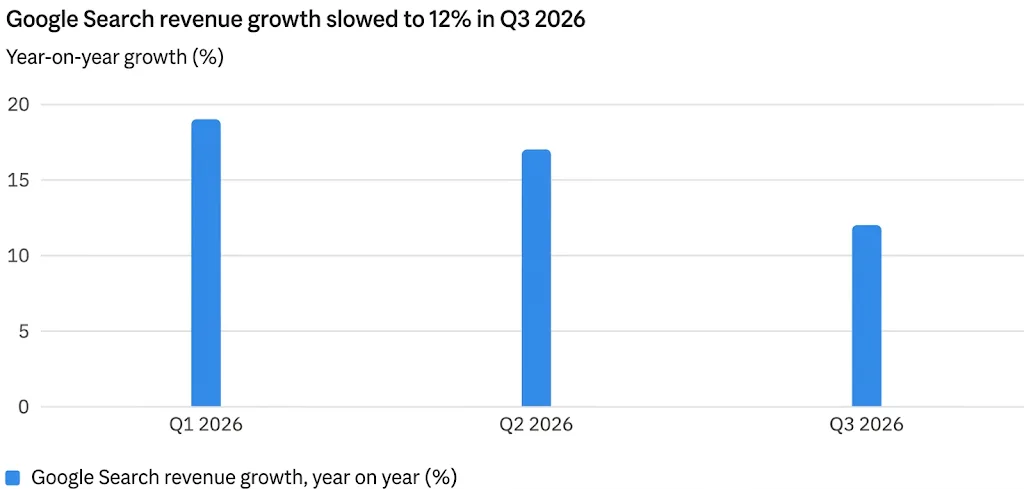
The timing is not an accident. Google shared the news alongside Alphabet's third-quarter 2026 results, as reported by TechCrunch. Alphabet's total revenue reached $127.6 billion, up 25% on the year before, and Google Cloud revenue grew 103% to $30.7 billion. But growth in Google Search revenue slowed to 12%, and Alphabet's shares fell 8% after the results.
At the same time, Google CEO Sundar Pichai said Search queries grew at their fastest year-on-year rate in five years, although he did not give the figure. He also said that one in five AI Mode searches globally involves voice, images or documents, and that Google has passed 50 billion visual searches a month.
Put those together and the logic is clear. People are searching in new ways, and Google needs those new searches to earn money. The chart below shows how Search revenue growth has eased through 2026.
It is expected that Google may keep adding ad formats, automation and experiments in AI search over the coming months. That rewards advertisers who are prepared and punishes those who wait for a perfect set of instructions.
AI Overviews, AI Mode and Google Search Ads: what is the difference?
These terms get muddled, so here is a plain comparison.
| Classic Google Search Ads | AI Overviews | AI Mode |
|---|
What it is | Text ads on the standard results page, triggered by searches | AI-generated summaries that appear on the results page | A conversational search experience for longer questions and follow-ups |
How people search | Short, keyword-style queries | Everyday queries on the normal results page | Longer, conversational queries, three times longer on average according to Google |
Ads | Established formats and controls most advertisers already know | Google says it is scaling ads within AI Overviews and AI Mode to more users and queries | Labelled "Sponsored", now scaling to more countries |
UK status | Live | Check your own account and Google's latest updates | Planned for Q4 2026, no date given |
One caution. Google's announcements do not explain how advertisers will target, bid on or report on AI Mode placements in the UK. Anyone who claims to know those details today is guessing.
What does this mean for UK businesses?
Google names the United Kingdom as a planned location, not a live one. That gives you a window. The sensible use of it is preparation: clean data, strong landing pages and a clear test plan, rather than rushing budget into something that has no UK results yet.
What has not changed
The basics still decide who wins. You still need clear goals, trustworthy conversion tracking, relevant landing pages and a budget you can afford to test. Ads are labelled, and Google's rules against misleading ads still apply. If you use AI tools to create ad images or video, our guide to the new AI ad disclosure rules explains what to declare.
A quick word on Google AdWords
Plenty of people still say Google AdWords. Google renamed it Google Ads in 2018, and it is the same advertising platform, now covering Search, Shopping, Display, YouTube and more. If a supplier still talks about Google AdWords, ask them to show you what they actually do inside a current Google Ads account.
Practical examples: three UK scenarios
UK ads in AI Mode have not launched, so we cannot share UK results. The scenarios below are illustrations of how a conversation might unfold and what each business should have ready. They are not client results.
Business | A possible conversation | What to have ready |
|---|
Online outdoor retailer | First question: "Best waterproof jacket for the Lake District under £150." Follow-up: "Does it come in a wide fit, and how fast is delivery?" | A product feed with accurate titles, sizes, prices, stock, delivery and returns details. A product page that answers fit questions. Google Shopping campaigns that already perform |
Leeds accountancy firm | First question: "When should a sole trader earning £60,000 switch to a limited company?" Follow-up: "Who can help me in Yorkshire?" | A plain-English page on the topic, a simple enquiry form, call tracking, and ad copy that answers the question and states your location |
Manchester B2B software firm | First question: "Which invoicing software works with Xero and handles VAT for UK subcontractors?" Follow-up: "Is there a demo?" | Integration pages, an honest comparison page, and a demo booking page with conversion tracking switched on |
Eight actionable tips to prepare your Google Ads account
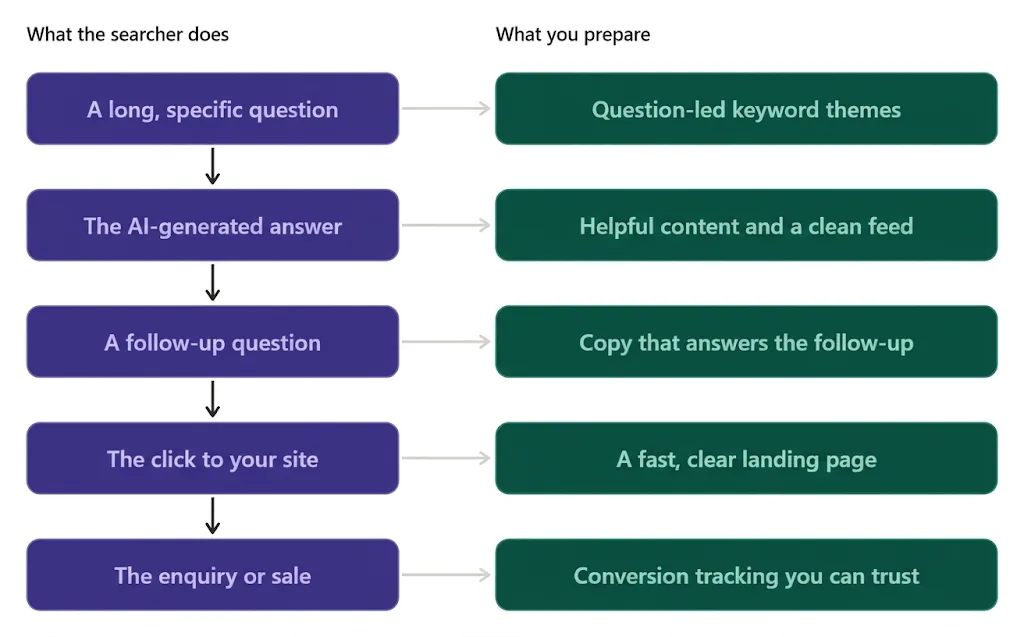
Longer, conversational searches change what each step of the journey asks of your campaign. The diagram below maps a conversational search from the first question to the sale, with the preparation that goes with each step. The eight tips that follow build on it.
1. Audit your tracking before you add budget
If your Google Ads account cannot tell you which clicks became enquiries or sales, you cannot judge any new placement fairly. Check that conversions fire once per real action, that Google Analytics 4 and Google Ads broadly agree, and that both phone calls and form submissions are counted. This is the most useful job to finish before the UK launch.
2. Tidy your product feed if you sell products
Product ads draw on the data in your Google Merchant Center feed. Check titles, prices, availability, sizes, delivery costs and returns details, and fix any disapproved items. Accurate data matters even more when a shopper asks a follow-up question about delivery or fit.
3. Build keyword themes around full questions
Collect the questions your customers really ask. Good sources are Search Console queries, sales calls, customer emails, live chat and the search terms report in Google Ads. Group them by intent, such as comparing, pricing or "near me", then check that each theme has both an ad and a page that fits it.
4. Write ads that answer, not just announce
Specific copy beats generic copy. Compare these two examples (example copy only):
The second answers the question a searcher is actually weighing. Keep every claim accurate, because ads are labelled "Sponsored" and trust is part of the click.
5. Make the landing page answer the follow-up
People who arrive from a conversation have already asked one or two questions. Give them the next answer quickly: pricing guidance, delivery and returns, proof, FAQs and one clear action. Check that the page loads fast on mobile and matches the promise in the ad.
6. Ring-fence a small, capped test budget
When the UK launch arrives, test with money you can afford to lose. A slice of 5 to 10 per cent of your Google Ads spend is a reasonable starting point for your own planning, but it is our suggestion, not a Google recommendation. Agree in advance what success looks like, how long the test runs and which existing campaigns act as your comparison.
7. Judge results by business outcomes, not clicks
Click-through rate is a start. Cost per lead, lead quality, revenue and return on ad spend tell you far more. Watch for overlap with your existing Google Search Ads and brand campaigns so you do not pay twice for the same customer. Ask your agency what AI Mode reporting is available as soon as Google confirms it.
8. Keep SEO and paid search working together
AI Overviews and AI Mode draw on content from across the web, and Google's own guidance for creators asks for helpful, reliable, people-first content. Pages that answer real questions clearly help your organic visibility and your paid landing page quality at the same time. That is why we pair SEO with paid advertising.