Every founder remembers the moment their app idea finally clicked into place. Fewer remember the process of finding someone to build it quite so fondly. Search for mobile app development services online, and you will find thousands of agencies, freelancers, and studios, all claiming to be the perfect fit, all quoting wildly different prices for what sounds like the same project.
Here is the uncomfortable truth: the gap between a smooth launch and a stalled, over-budget mess usually comes down to one decision: who you choose to build it. Get that right, and everything else (the design, the development, the testing, the launch) tends to fall into place. Get it wrong, and no amount of budget or enthusiasm will rescue the project.
This guide is built to help you get that decision right. Treat it as a practical checklist you can run through with any mobile app development company before you sign a single contract, whether you are talking to a boutique studio down the road or a specialist mobile app agency in London.
Why the Right Mobile App Development Services Make or Break Your Launch
An app is rarely just an app. For most founders, it is the product, the pitch deck and the proof of concept, all rolled into one. If it works well, it can attract investors, win customers and validate months (or years) of planning. If it does not, the damage goes well beyond a bad app store review.
Poor mobile app development services tend to cost you three things at once: money, time and credibility. Rebuilding after a failed first attempt rarely costs the same as building it properly the first time; it costs more, because you are now paying to untangle someone else's decisions before you can move forward. Meanwhile, competitors who chose well are already live, gathering feedback and iterating.
This is why the selection process deserves more attention than most founders give it. A quick search and a decision based purely on price is how good ideas end up as bad apps.
What Great Mobile App Development Services Actually Look Like
Before you can evaluate an agency, it helps to know what a well-run project should look like. Reputable mobile app development services rarely jump straight into code. Instead, they follow a structured path designed to catch problems while they are still cheap to fix.
Below is the journey most solid agencies, including ours, follow, from the first conversation to ongoing support.
1 Discovery & Strategy Define goals, users, and scope | 2 UX/UI Design Wireframes and visual design | 3 Development Build the front and back end | 4 Testing & QA Security and performance checks | 5 Launch App Store and Play submission | 6 Support Monitoring and improvements |
The stages founders most often underestimate are discovery and testing. Skipping proper discovery leads to scope creep later on. Skipping proper testing means bugs reach real users, which is a far more expensive place to find them.
In-House Team, Freelancer, or Mobile App Agency? Weighing Your Options
Before you start comparing individual companies, it is worth answering a bigger question: should you hire in-house, bring in a freelancer, or work with a dedicated mobile app agency? Each route has its place, depending on your budget, timeline, and how much ongoing development you expect to need.
The table below breaks down how the three typically compare.
Factor | In-House Team | Freelance Developer | Mobile App Agency |
|---|---|---|---|
Upfront cost | High: salaries, equipment, benefits | Low to medium | Medium to high, scoped upfront |
Speed to start | Slow: recruitment can take months | Fast | Fast to medium |
Skill range | Limited to who you hire | Limited to one person's skills | Broad: design, development, QA and project management |
Reliability | High once the team is hired | Variable | High, backed by a full team |
Best suited to | Large, ongoing product teams | Small, well-defined tasks | Founders who need a complete build, start to finish |
For most founders building a first app, a mobile app agency offers the best balance. You get a full team (design, development, QA and project management) without the overhead of hiring one, and without betting the entire project on a single freelancer's availability.
Founder's tip: Ask every agency the same set of questions, in the same order. It is the fastest way to compare like with like once the meetings start blurring together. |
The Founder's Checklist: 10 Things to Evaluate in Any Mobile App Development Company
This is the part worth bookmarking. Whether you are speaking to a local studio or a specialist mobile app development London team, run through these ten points before you sign anything.
1. A Portfolio That Matches Your Type of Project
Anyone can show you a slick app screenshot. Ask deeper questions: what problem did that app solve, how many users does it have now, and is it still being maintained? A mobile app agency with experience in your sector (fintech, healthcare, retail, logistics) will ask you sharper questions in the first meeting than one that has never touched your industry.
2. Full-Stack Technical Range
Your app needs a front end people enjoy using, a back end that does not fall over under load, and often a database, APIs, and cloud infrastructure behind it. Ask which languages and frameworks they use (React Native and Flutter for cross-platform, Swift for iOS, Kotlin for Android are common, solid choices) and why they would recommend one over another for your specific app.
3. Transparent, Itemised Pricing
A trustworthy quote breaks costs down by phase (design, development, testing, deployment) rather than handing you a single number with no explanation. If an agency cannot explain what is included in that figure, or will not put it in writing, that is worth noticing.
4. A Clear Communication Process
Ask who your main point of contact will be, how often you will get updates, and what tools they use to track progress (Jira, Trello, Asana, or similar). Weekly check-ins and shared access to a project board are good signs that you will not be left guessing for weeks at a time.
5. A Genuine Post-Launch Support Plan
Launch day is the start of an app's life, not the end of the project. Ask what happens after go-live: who fixes bugs, how quickly, and at what cost. A 24-hour response time for urgent issues is a reasonable benchmark to ask for.
6. Security and Compliance Credentials
If your app handles personal data, payments, or health information, security cannot be an afterthought. Look for evidence of GDPR-aware development practices and recognised certifications such as ISO 27001 or Cyber Essentials Plus. These are not just badges; they show a company has been independently audited on how it handles data.
7. Design That Goes Beyond Looking Good
Good UI/UX design is measured in conversions and retention, not compliments. Ask to see before-and-after examples of apps the team has redesigned, and what changed in user behaviour afterwards.
8. Realistic, Justified Timelines
A simple app typically takes a few months to build properly; a more complex, feature-rich product can take considerably longer. Be wary of anyone promising a fully-featured app in a matter of weeks. It is usually a sign that testing (or your requirements) will be cut short.
9. Clear Intellectual Property Terms
Confirm, in writing, that you own the source code, design files and any assets created for your project once the final invoice is paid. Some agencies retain rights to reusable components; if that is the case, make sure the contract says so clearly.
10. References You Can Actually Contact
Case studies are useful, but a short call with a past client tells you more in ten minutes than a portfolio page tells you in an hour. Ask what went well, what did not, and whether they would hire the same mobile app development company again.
Your Quick-Reference Checklist
# | What to Check |
|---|---|
1 | ☐ Relevant portfolio and case studies |
2 | ☐ Full-stack technical expertise |
3 | ☐ Transparent, itemised pricing |
4 | ☐ Clear communication process |
5 | ☐ Genuine post-launch support plan |
6 | ☐ Security and compliance credentials |
7 | ☐ UI/UX design that drives results |
8 | ☐ Realistic, justified timelines |
9 | ☐ Clear intellectual property terms |
10 | ☐ Contactable past clients |
Red Flags to Watch Out For When Vetting a Mobile App Agency
Alongside what to look for, it helps to know what should make you pause. Picture this: a founder gets three quotes for the same app. Two agencies quote around £45,000 with a clear breakdown. The third quotes £15,000, with a two-week turnaround and no written scope. It is tempting to take the cheaper option, especially early on, but that gap usually means something is missing: proper testing, ongoing support, or real experience with a similar build.
The table below lists common warning signs and what they usually mean in practice.
Red Flag | What It Usually Means |
|---|---|
Quote far below every other estimate | Corners are likely being cut on testing, security, or support |
No written scope of work | Expect scope creep and disputed invoices later |
Reluctant to share references | Past clients may not have had a great experience |
Vague answers about code ownership | You may not fully own your own app |
Promises a complex app in a few weeks | Testing and quality assurance are likely to be rushed |
Only one junior point of contact | No real oversight if something goes wrong |
None of these signs is necessarily a dealbreaker on its own, but two or three together are a strong reason to keep looking.
Why Location Still Matters: The Case for a Mobile App Development Company in London
With remote work now the norm, some founders assume location does not matter for a build like this. In practice, it still does, particularly for a UK business.
A mobile app development company in London, or elsewhere in the UK, shares your time zone, so calls and reviews happen during your working day rather than at midnight. They also tend to have a working knowledge of UK-specific requirements: UK GDPR, App Store and Google Play guidelines as they apply to UK businesses, and the expectations of UK users, who behave differently from users in other markets.
There is also something to be said for sitting in a room together when a project hits a genuinely tricky decision. GSS Tech Solutions, for example, is based in Rainham, London, which means clients across the UK can meet the team face-to-face when it matters, rather than relying entirely on video calls across time zones.
What Do Mobile App Development Services Cost in the UK?
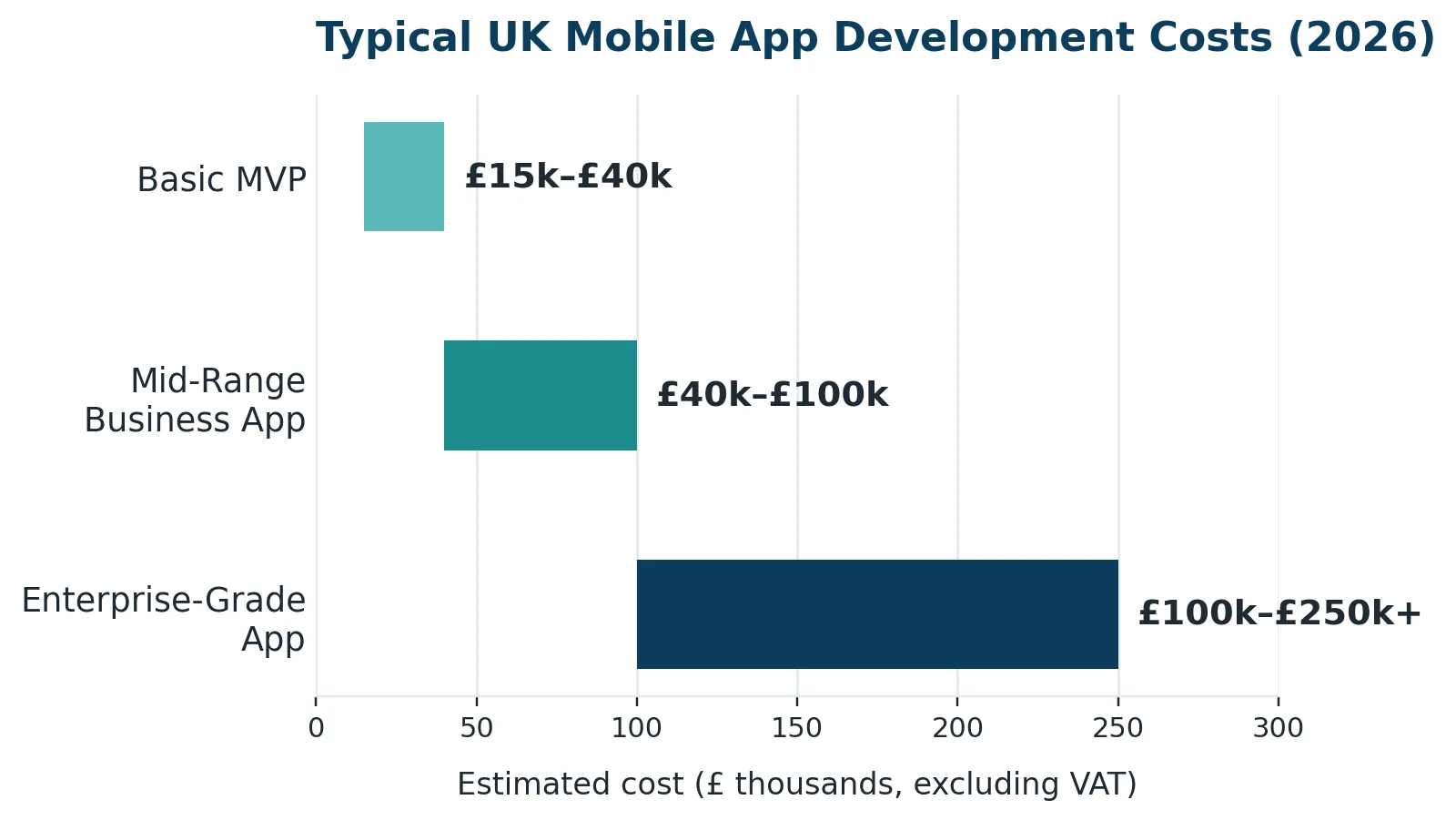
Cost is usually the first question founders ask, and reasonably so. The honest answer is that it depends on complexity, platform choice, and how much custom design and integration work your app needs. That said, most UK projects fall into one of three general bands.
Project Type | Typical UK Price Range | Typical Timeline |
|---|---|---|
Basic MVP: core features, one platform or simple cross-platform | £15,000 to £40,000 | 3 to 4 months |
Mid-range business app: custom design, backend, integrations | £40,000 to £100,000 | 4 to 8 months |
Enterprise-grade app: complex logic, high security, integrations | £100,000 to £250,000+ | 6 to 12+ months |
Founder's tip: Ask for the quote broken down by phase. If a company cannot itemise a £60,000 figure, it has probably not thought the project through either. |
These figures exclude VAT and ongoing costs such as hosting, app store fees and maintenance, which typically add another 15 to 20 percent per year once your app is live. As a rule of thumb, the cheapest quote on the table rarely turns out to be the cheapest app once support, fixes and rework are factored in. It pays to compare mobile app development services on value, not just the headline number.
Smart Questions to Ask Before You Sign
A short discovery call tells you a lot, provided you ask the right things. Bring these questions to your first conversation with any mobile app agency.
Question to Ask | Why It Matters |
|---|---|
“Can you show me an app similar to mine that you've built?” | Confirms relevant, hands-on experience |
“What is included in this quote, and what is not?” | Prevents scope disputes later on |
“Who will actually be working on my project?” | Confirms you are not handed to a junior team after the pitch |
“What happens if I need changes after launch?” | Reveals the real ongoing cost of the relationship |
“Can I speak to a past client?” | The fastest way to validate everything else you have been told |
If an agency answers these clearly and without hesitation, that is a strong signal you are in good hands.
Frequently Asked Questions
How much do mobile app development services cost in the UK?
Most UK projects range from around £15,000 for a simple MVP to £250,000 or more for a complex, enterprise-grade app. Mid-range business apps with custom design and integrations typically fall between £40,000 and £100,000.
How long does it take to build a mobile app?
A straightforward app usually takes three to four months from discovery to launch. More complex apps, with custom backends, multiple integrations or advanced security requirements, can take six months to a year or longer.
Should I hire a mobile app development company in London, or work with an offshore team?
Either can work well, but a London-based mobile app agency offers time zone alignment, familiarity with UK regulations and the option of in-person meetings. Offshore teams can offer lower rates, though communication gaps and time differences can slow decisions down.
What is the difference between a mobile app agency and a freelance developer?
A mobile app agency provides a full team (design, development, QA, and project management) under one contract, with built-in redundancy if someone leaves. A freelancer is usually more affordable for small, well-defined tasks, but the entire project depends on one person's availability and skill set.
Do I need separate teams for iOS and Android?
Not necessarily. Cross-platform frameworks such as React Native and Flutter let one team build for both platforms from a single codebase, which is usually faster and more cost-effective than building two native apps. Native development is still worth considering for apps that need maximum performance or deep access to device hardware.
What ongoing costs should I budget for after launch?
Budget for hosting, app store fees, monitoring, bug fixes, and periodic updates for new operating system versions. As a rough guide, ongoing maintenance typically costs 15 to 20 percent of the original build cost per year.
How do I know if a mobile app development company is genuinely good?
Look past the marketing and check for a relevant portfolio, transparent pricing, contactable references, clear IP terms and a defined post-launch support plan. If a company can answer every point on this checklist clearly and in writing, that is a strong sign you are dealing with a genuine, capable mobile app development company.
Final Words: Choose a Partner, Not Just a Vendor
Choosing the right company is rarely about finding the cheapest mobile app development services or the flashiest portfolio. It is about finding a team that asks good questions, explains its pricing, stands behind its work after launch, and treats your idea with the same care you do.
Run any shortlist through the checklist in this guide: portfolio, technical range, transparent pricing, communication, support, security, design quality, realistic timelines, IP terms and references. Do that, and you will walk into any conversation with a mobile app agency knowing exactly what a good answer sounds like, and exactly when to walk away from a poor one.
If you are currently comparing mobile app development services and would like a second opinion, GSS Tech Solutions has been building mobile apps for UK businesses for more than eight years, backed by ISO 27001 and Cyber Essentials Plus certification and a 99% client satisfaction record. Get in touch for a free, no-obligation quote, and let's talk through what your app actually needs.
Ready to build something that lasts? Talk to GSS Tech Solutions about your mobile app development services. Phone: 0203 599 8122 Email: contact@gsstechsolutions.co.uk gsstechsolutions.co.uk/services/mobile-app-development-company |